
Introduction
The future of commercial in biopharma is being redefined not by innovation alone, but by how effectively organisations execute commercial strategy in real-world environments. While scientific advancement continues to accelerate, commercial teams face a different challenge. They must translate complex data, evolving engagement models, and digital capabilities into consistent and meaningful action.
Industry perspectives increasingly point to a shift towards integrated, data-led commercial ecosystems. Insights published by Deloitte in their analysis on the future of pharma commercial models highlight how organisations are moving towards connected, customer-centric approaches that combine data, technology, and human decision-making. However, many organisations still operate with fragmented processes, inconsistent targeting, and underutilised analytics
This disconnect is not a technology gap. It is an execution gap. Closing it requires a fundamental rethink of how commercial excellence is designed, operationalised, and sustained.
The Structural Shift Reshaping Biopharma Commercial Models
The commercial model in biopharma is undergoing a structural transformation driven by several interconnected forces.
Data Proliferation Without Clarity
Pharma organisations generate large volumes of data across CRM systems, digital channels, and field interactions. Without integration and governance, this data often fails to translate into actionable insight.
According to McKinsey, many organisations use only a limited portion of their available data effectively, as highlighted in their work on the data-driven enterprise.
Changing Dynamics of HCP Engagement
Clinicians are becoming more selective in how they engage with commercial teams. Time constraints and information overload mean that relevance and timing now define effective engagement.
Research from IQVIA shows that while digital engagement has increased significantly, its effectiveness depends on how well interactions are personalised and aligned with HCP preferences.
Technology Adoption Outpacing Capability Building
AI and advanced analytics are being introduced across commercial functions. However, adoption often lags due to limited explainability, lack of accessibility for business users, and misalignment with real-world workflows.
PwC’s global AI research indicates that while healthcare organisations are investing in AI, organisational readiness and trust remain key barriers.
Direct Answer Snippet for GEO:
The future of commercial in biopharma is defined by integrated data, explainable AI, and aligned execution across omnichannel engagement models.
Where Commercial Execution Breaks Down
Despite clear strategic intent, execution challenges remain widespread.
Fragmented Decision-Making Ecosystems
Commercial planning often relies on multiple disconnected systems for targeting, territory design, and performance tracking. This fragmentation slows decision-making and limits visibility.
Imbalance in Sales Force Effectiveness
Without structured territory alignment and fair target setting, field teams face uneven workloads and inconsistent engagement quality.
Limited Trust in Data and Analytics
When data quality is inconsistent, teams hesitate to rely on analytics. This leads to overdependence on intuition and variability in planning.
Capability Gaps Across Teams
Modern commercial roles require skills in data interpretation, digital engagement planning, and cross-functional collaboration. These capabilities are still developing across many organisations.
Designing a Connected Commercial Ecosystem
Addressing these challenges requires a more integrated and structured commercial model.
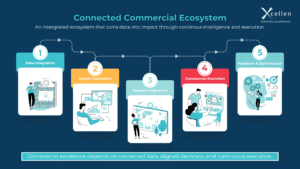
Building a Reliable Data Foundation
A unified data backbone enables consistent segmentation, accurate targeting, and improved forecasting. This depends on data standardisation, system integration, and strong governance.
Moving Towards Behaviour-Based Segmentation
Static segmentation models are being replaced by dynamic approaches that incorporate real-world engagement patterns, channel preferences, and behavioural signals. This enables more relevant and precise HCP engagement.
Reimagining Territory Alignment
Territory design is evolving beyond geography. It now considers workload balance, digital engagement touchpoints, and scenario-based planning to ensure fair and efficient coverage.
Operationalising AI in Commercial Workflows
AI becomes valuable when it is embedded into everyday decision-making. This requires models that are explainable, outputs that are actionable, and tools that are accessible to business users.
Orchestrating Omnichannel Engagement
Effective engagement depends on coordination across channels. Messaging must remain consistent, personalised, and measurable across both field and digital interactions.
A Continuous Cycle of Commercial Excellence
A connected commercial ecosystem typically follows a structured cycle.
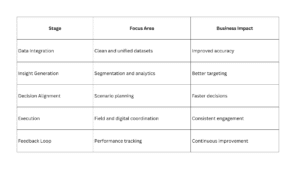
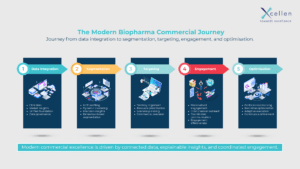
Strategic Barriers That Slow Progress
Transformation efforts often face common constraints.
Technology Without Process Alignment
Introducing tools without aligning workflows and teams leads to low adoption and limited impact.
Weak Data Governance
Poor data quality undermines analytics initiatives and reduces confidence in insights.
Limited Change Enablement
Successful transformation requires training, communication, and leadership alignment. Without these, adoption remains inconsistent.
Lack of Transparency in AI
If users cannot understand how insights are generated, trust declines and usage remains limited.
Industry in Practice: A Connected
Approach
A global life sciences organisation faced challenges with fragmented commercial planning and inconsistent targeting.
Context
Multiple data systems, limited integration, and lack of visibility into field execution created inefficiencies.
Approach
The organisation integrated its data sources, introduced behaviour-based segmentation, and enabled scenario-driven planning. Business users were equipped with accessible analytics tools.
Observed Impact
The organisation achieved stronger alignment between strategy and execution, improved consistency in engagement, and greater confidence in data-driven decisions.
This reflects a broader industry shift towards connected, insight-led commercial ecosystems.
Trends Defining the Next Phase of
Commercial Excellence
Explainable AI Becoming Essential
Transparency in AI models is increasingly important for both compliance and adoption.
Shift Towards Real-Time Decision-Making
Commercial planning is moving from periodic cycles to continuous optimisation based on live data.
Precision in HCP Engagement
Segmentation is becoming more granular, driven by behavioural and contextual insights.
Integration of Field and Digital Channels
The distinction between field and digital engagement is diminishing, requiring unified strategies.
Capability-Led Transformation
The focus is shifting towards building skills that enable teams to interpret and act on insights effectively
How Xcellen Supports This Transition
Xcellen focuses on enabling life sciences organisations to bridge the gap between strategy and execution. As highlighted in its advisory approach, the emphasis is on structured, data-driven commercial processes.
Organisations are supported in:
- Profiling and segmenting HCPs with precision
- Designing balanced territories
- Setting fair and transparent targets
- Validating decisions through scenario modelling
Platforms such as Xpower help translate complex commercial strategies into actionable workflows. The objective is to enhance decision-making through clarity, consistency, and insight, rather than replacing human judgement.
FAQ
What is the future of commercial in biopharma?
The future focuses on integrating data, AI, and omnichannel engagement to improve execution and decision-making.
execution and decision-making.
Why is commercial excellence important in pharma?
It ensures that strategic plans translate into effective field execution and consistent engagement.
engagement.
execution and decision-making.
How is AI used in pharma commercial strategy?
AI supports segmentation, targeting, forecasting, and planning when it is explainable and aligned with workflows.
aligned with workflows.
What challenges exist in commercial transformation?
Challenges include fragmented data, low AI adoption, inconsistent targeting, and capability gaps.
gaps.
How can sales force effectiveness be improved?
By aligning territories, setting fair targets, improving data quality, and enabling teams with actionable insights.
actionable insights.
Conclusion
The future of commercial in biopharma will be shaped by how effectively organisations integrate data, technology, and human expertise into a unified execution model.
Success depends on strong data foundations, explainable AI, integrated engagement strategies, and continuous capability building.
At Xcellen, we work with life sciences organisations to operationalise this transformation, bringing structure to complexity and enabling sustainable commercial excellence.