
AI is increasingly present in vaccination strategy discussions. Forecasts are becoming more sophisticated, segmentation models are becoming more granular, and data availability continues to expand.
Yet many organisations face a familiar challenge. AI insights exist, but they are not consistently embedded into planning and execution.
The focus is therefore shifting. The question is no longer whether AI can support vaccination planning. It is how organisations can implement it in a way that aligns with real-world commercial workflows.
Why Implementation Often Falls Short
AI initiatives in vaccination planning often begin with strong intent but encounter friction during execution. This is not due to limitations in the technology itself. It is often the result of gaps in how AI is integrated into planning processes.
Common challenges include:
- Insights generated in isolation from commercial teams
- Forecasts that are not reflected in the territory or field plans
- Segmentation outputs that remain static over time
- Limited visibility of AI-driven recommendations for field teams
- Misalignment between central strategy and regional execution
These gaps highlight an important reality. AI creates value only when it is embedded into decision-making processes.
According to a report by McKinsey & Company, advanced analytics can improve demand forecasting accuracy in healthcare supply chains by 20 to 30 per cent, but only when integrated into operational workflows.
This reinforces that insight alone is not enough. Execution alignment is critical.
A Structured Approach to Implementing AI
Organisations that successfully implement AI in vaccination planning tend to follow a structured approach. This ensures that insights are not only generated but also used effectively.
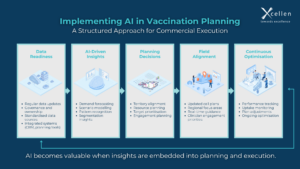
1. Establishing a Data Foundation
AI depends on data consistency and accessibility. Before implementing models, organisations need to ensure that their data environment is structured and reliable.
This includes:
- Standardised data definitions across systems
- Regular data refresh cycles
- Integration between planning, CRM, and analytics platforms
- Clear governance around data ownership
Without this foundation, AI outputs can become inconsistent, reducing trust and adoption.
A study by Deloitte highlights that organisations with strong data governance are significantly more likely to scale AI initiatives successfully.
2. Connecting Forecasting with Planning Decisions
Forecasting is often treated as a standalone activity. However, in vaccination planning, forecasts need to directly influence planning decisions.
This means:
- Using forecasts to guide territory design
- Aligning demand projections with resource allocation
- Updating plans based on scenario modelling
- Ensuring forecasts are accessible to commercial teams
When forecasting is integrated into planning, it becomes a decision tool rather than a reporting output.
The World Health Organisation emphasises that data-driven planning improves immunisation coverage and reduces resource inefficiencies in large-scale programmes.
3. Translating Segmentation into Action
Segmentation is most valuable when it informs engagement and field activity.
AI-driven segmentation can highlight:
- High-priority regions for vaccination initiatives
- Clinicians with higher engagement potential
- Areas where awareness efforts may be required
- Institutional versus individual influence patterns
However, these insights need to be reflected in:
- Call plans
- Engagement strategies
- Territory alignment
- Content planning
4. Aligning Field Teams with AI Insights
Field teams are central to vaccination strategy execution. If AI insights do not reach them in a usable format, their value is limited.
Effective implementation requires:
- Clear communication of priorities
- Integration of insights into existing tools
- Regular updates based on new data
- Practical guidance that supports day-to-day decisions
This ensures that AI becomes part of routine workflows rather than an external input.
According to PwC, more than 70 per cent of healthcare professionals prefer a mix of digital and in-person engagement. This highlights the need for aligned, data-driven engagement strategies.
5. Building Continuous Feedback Loops
Vaccination planning is dynamic. Uptake patterns, regional conditions, and engagement levels can change over time.
AI can support continuous improvement by:
- Monitoring performance trends
- Identifying deviations from expected outcomes
- Highlighting areas requiring attention
- Supporting timely adjustments
This creates a planning cycle that evolves with real-world data rather than relying on static assumptions.
The Role of Platforms in Enabling Implementation
Technology platforms play a key role in bridging the gap between AI insights and execution.
They help:
- Consolidate data from multiple sources
- Enable scenario modelling
- Align planning with field execution
- Provide visibility across teams
At Xcellen, we observe that organisations benefit when AI capabilities are embedded within structured commercial planning environments, where data, strategy, and execution are connected.
Key Considerations for Sustainable Adoption
Implementing AI in vaccination planning is not a one-time initiative. It requires ongoing alignment across teams, systems, and processes.
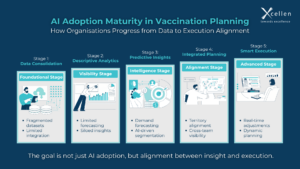
Important considerations include:
Explainability
Teams need to understand how AI models generate insights. This supports trust, adoption, and compliance.
Usability
Insights should be accessible and easy to interpret for both central teams and field teams.
Flexibility
Planning frameworks should allow for adjustments as new data becomes available.
Collaboration
Cross-functional alignment between data, commercial, and field teams is essential.
What Progress Looks Like
Organisations that implement AI effectively often demonstrate:
- Strong alignment between forecasting, segmentation, and field planning
- Increased visibility of planning data across teams
- Faster response to changes in demand
- More structured engagement strategies
- Better coordination between central and regional teams
These improvements reflect stronger planning discipline rather than reliance on technology alone.
Closing Perspective
AI in vaccination planning is evolving beyond experimentation. The focus is now on practical implementation and integration into everyday workflows.
Organisations that move forward successfully treat AI as part of a broader commercial planning capability, supported by clean data, structured processes, and aligned execution.
Because in vaccination strategy planning, the real advantage lies not in having more data, but in using that data effectively.
FAQ
AI in vaccination planning is evolving beyond experimentation. The focus is now on practical implementation and integration into everyday workflows.
Organisations that move forward successfully treat AI as part of a broader commercial planning capability, supported by clean data, structured processes, and aligned execution.
Because in vaccination strategy planning, the real advantage lies not in having more data, but in using that data effectively.
1. What does implementing AI in vaccination planning involve?
It involves integrating AI-driven insights into planning workflows such as forecasting, segmentation, territory design, and field execution.
2. Why do AI initiatives fail in vaccination strategy planning?
Failures often occur due to poor data quality, lack of integration with planning tools, and limited alignment between insights and execution.
3. How can organisations improve AI adoption in commercial teams?
By ensuring insights are explainable, accessible, and embedded into existing workflows used by planning and field teams.
4. What role do field teams play in AI-driven vaccination planning?
Field teams use AI-driven insights to prioritise engagement, plan interactions, and align activities with regional vaccination strategies.
5. Is AI only useful for large-scale vaccination programmes?
No. AI can support planning at multiple levels, including regional and targeted vaccination initiatives.
6. How often should AI models be updated in vaccination planning?
Models should be updated regularly based on new data to ensure forecasts and segmentation remain relevant.
For further reading on segmentation and engagement strategy, visit:
https://www.xcellen.com/resources/