Which Channel Actually Drives Prescriptions?
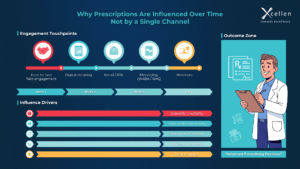
When conversations turn to which channels influence prescribing, the phrase “driving prescriptions” often comes up quickly, and just as often, it is misunderstood. In pharma marketing, this does not imply control over clinical decision-making. Instead, prescribing behaviour reflects the combined effect of multiple influences that develop over time through repeated, credible engagement.
These influences typically include the quality of professional relationships, confidence in scientific and educational exchange, the relevance and timing of information, trust in the engagement channel, and the ethical and compliant nature of commercial interactions. Together, they shape how healthcare professionals interpret information and apply it within real-world prescribing contexts.
Large-scale industry analyses and peer-reviewed research consistently show that prescription influence is multi-dimensional. Evidence indexed in ScienceDirect and PubMed indicates that field engagement, digital detailing, educational initiatives, and informational content can all contribute to changes in prescribing patterns. However, no single pharma engagement channel acts independently or delivers deterministic outcomes.
Seen this way, any assessment of prescription influence channels must focus on how engagement supports informed decision-making across touchpoints rather than assuming linear cause-and-effect relationships. Maintaining this perspective is essential for realistic expectations, responsible execution, and ethical commercial engagement.
Face Field Engagement in Pharma: Still the Reference Point for Speciality Drugs
Despite the expansion of digital channels, face-to-face field engagement in pharma continues to serve as a reference point for many commercial teams, particularly in speciality and complex therapy areas.
In-person interactions enable depth that is difficult to replicate elsewhere. They support:
- Trust-based relationship building
- Two-way scientific exchange
- Real-time clarification and dialogue
- Contextual understanding of individual HCP needs
Research from McKinsey & Company indicates that while HCPs increasingly expect flexible engagement options, face-to-face interactions remain especially valuable for nuanced scientific discussions and confidence-building over time. This does not suggest exclusivity, but it reinforces the enduring role of human interaction within modern engagement models.
From an SEO perspective, face-to-face field engagement in pharma remains closely associated with high-quality influence when execution is disciplined, insights-led, and respectful of HCP time constraints.
Digital / Remote Detailing: Scalable, but Execution-Dependent
Digital detailing in pharma, spanning video calls, phone calls, text-enabled interactions, and virtual meetings, offers flexibility that aligns well with the realities of time-poor clinicians.
Its advantages include scalability, consistency, and broader reach. However, effectiveness varies significantly based on execution. Deloitte research on hybrid commercial models shows that digital interactions deliver value when they are:
- Owned by the representative, not automated in isolation
- Personalised to the HCP’s context
- Timed appropriately within the engagement journey
Without these conditions, digital detailing risks becoming transactional rather than influential. The channel itself does not determine impact; the design and integration of the interaction do. As a result, digital detailing in pharma performs best when it complements rather than replaces trusted field relationships.
HQ Email: Reach Without Relationship
HQ-driven email remains one of the most widely used pharma engagement channels due to its scale, cost efficiency, and governance control.
Its strengths are clear:
- Broad reach across HCP segments
- Message consistency
- Strong compliance oversight
However, industry benchmarks consistently show a gap between email open rates and meaningful downstream action. Without contextual relevance or alignment with field activity, HQ emails often struggle to influence behaviour.
The limitation is not the channel itself, but its frequent disconnection from field insight. Emails that are not reinforced or anticipated by representative engagement tend to operate in isolation, reducing their role within broader prescription influence channels.
RTE – Rep Triggered Email: Where Channels Start to Converge
Rep Triggered Email (RTE) occupies a distinctive position within omnichannel models because it combines digital efficiency with human context.
Unlike HQ emails, RTEs are typically:
- Initiated by representatives
- Triggered by live interactions or specific events
- Aligned to ongoing conversations
Their effectiveness lies in relevance and continuity. When embedded into field workflows, RTEs reinforce discussions rather than attempting to replace them. This convergence explains why rep-triggered email RTE is often perceived differently by both HCPs and field teams. It is not simply another digital channel but a bridge between physical and digital engagement.
WABA & SMS: Immediacy With Boundaries
WhatsApp Business Accounts (WABA) and SMS introduce immediacy into pharma engagement, offering high visibility and rapid response potential.
These channels are particularly effective for:
- Appointment confirmations
- Event reminders
- Short, contextual nudges
However, their power demands discipline. PwC research into digital trust and communication fatigue highlights that overuse or poorly governed messaging can quickly erode credibility.
In the context of WhatsApp Business Accounts pharma engagement, success depends on explicit opt-in, clear governance frameworks, and tight message relevance. Without these safeguards, immediacy can become intrusion, undermining long-term trust.
Webinars: Depth Without Continuity
Webinars remain valuable for scientific education and large-scale knowledge sharing. They enable depth, expert access, and consistency across audiences.
Yet webinars alone rarely drive sustained prescribing influence. Their impact diminishes without pre-event alignment with field teams, post-event follow-up conversations, and integration into broader engagement plans. When disconnected from representative activity, webinars function as isolated touchpoints rather than components of an ongoing relationship.
Why No Channel Wins in Isolation
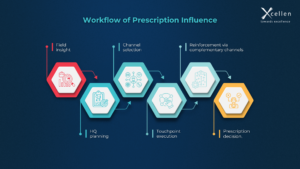
Across all channels, a consistent pattern emerges: prescribing influence does not originate from individual interactions but from how those interactions are orchestrated.
Effective omnichannel HCP engagement in pharma depends on:
- Clear role definition between HQ and field teams
- Data-driven sequencing of touchpoints
- Field-led insight informing channel selection
- Ethical design that respects HCP preferences
Accenture research shows that high-performing life sciences organisations do not prioritise channels in isolation. Instead, they design connected engagement systems that balance digital scale with human familiarity.
The question, therefore, is not which channel drives prescriptions, but how channels work together to support informed, confident decision-making.
Conclusion: Consistency Comes From Design, Not Channels
The most consistent prescription influence does not come from selecting the right channel. It comes from designing engagement systems that are
- Field-informed
- Ethically grounded
- Data-enabled
- Respectful of HCP needs and preferences
Commercial excellence lies in how pharma engagement channels are deployed, connected,
and governed, not in declaring a single channel superior. In a landscape defined by
complexity, orchestration, not choice, determines consistency.