
Vaccination planning has always required coordination across multiple stakeholders, timelines, and regions. What has changed in recent years is the volume of data available and the speed at which decisions need to be made. Planning cycles are shorter, populations are more mobile, and clinicians interact across multiple channels.
This growing complexity is one of the main reasons AI is becoming relevant in vaccination strategy planning. Not as a replacement for human decision-making, but as a support system that helps commercial and planning teams make sense of large, fragmented datasets and turn them into structured plans.
For life sciences organisations, vaccination strategy today is not just a supply exercise. It is a planning, segmentation, engagement, and execution challenge that requires coordination across commercial, field, and data teams.
The Planning Challenge in Vaccination Strategies
Vaccination uptake is influenced by multiple factors that often change over time:
- Regional population trends
- Access to healthcare infrastructure
- Clinician awareness and engagement
- Seasonality and disease patterns
- Policy and public health initiatives
- Availability of field resources
Traditionally, many of these decisions were based on historical data and broad assumptions. However, historical trends alone are no longer sufficient for accurate planning, especially when vaccination demand can shift quickly due to external factors.
AI helps organisations analyse patterns across multiple datasets at once, helping planners identify where demand is likely to increase, where engagement may be required, and where field teams should focus their time.
According to McKinsey, advanced analytics can improve forecast accuracy in healthcare supply chains by 20–30%, which can support better planning and allocation decisions.
The World Health Organisation has also highlighted the importance of data-driven planning in improving immunisation coverage and reducing resource wastage in large-scale vaccination programmes.
These trends indicate that vaccination strategy is increasingly dependent on how well organisations use their data.
AI plays a role in several planning areas, particularly where there are large datasets and multiple planning variables involved.
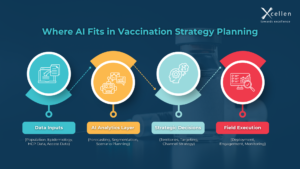
Demand Forecasting and Scenario Planning
AI models can analyse historical uptake, regional trends, clinician engagement, and demographic data to generate demand forecasts. These forecasts help organisations plan distribution, align field deployment, and prepare for different demand scenarios.
Scenario planning is particularly important in vaccination strategy because demand can vary significantly between regions and time periods. AI allows planners to test different scenarios and understand how changes in one variable may affect overall demand.
Population and Clinician Segmentation
Segmentation is central to any vaccination strategy. Not all regions, institutions, or clinicians behave in the same way, and broad targeting often leads to inefficient use of field resources.
AI can help identify patterns such as:
- Regions with historically high vaccination addoption
- Clinicians who influence institutional vaccination decisions
- Areas where engagement may be required to improve awareness
- Facilities with higher vaccination capacity
This allows commercial teams to prioritise efforts more effectively and design engagement plans that are aligned with real-world behaviour.
Territory Planning and Field Deployment
Field teams play an important role in vaccination campaigns, particularly in engagement, education, and coordination with healthcare institutions.
AI can support territory planning by analysing:
- Forecasted demand
- Clinician density
- Travel time and access
- Field workload distribution
- Regional engagement needs
This helps organisations deploy field teams more efficiently while maintaining balanced workloads, which is an important part of Sales Force Effectiveness.
Engagement Planning in an Omnichannel Environment
Clinicians now engage across multiple channels, including in-person meetings, virtual interactions, webinars, and digital content platforms. Because of this, vaccination engagement strategies need to be planned across channels rather than relying on a single interaction model.
AI can help organisations understand:
- Which channels do clinicians prefer
- How frequently should engagement happen
- What type of content is most relevant
- When engagement is most effective
A PwC report indicates that more than 70% of healthcare professionals prefer a mix of digital and in-person engagement, highlighting the importance of omnichannel planning in vaccination strategies.
This means vaccination strategy planning now includes not only supply and distribution decisions, but also structured engagement planning.
AI models can generate forecasts and recommendations, but in life sciences organisations, transparency is critical. Planning teams need to understand why a model is making a recommendation before they can act on it.
Explainable AI helps organisations understand:
- Which variables are influencing demand forecasts
- Why certain regions are prioritised
- Why are specific clinicians included in target lists
- How different scenarios may change outcomes
This level of transparency is important for internal alignment, compliance, and trust in AI-driven planning.
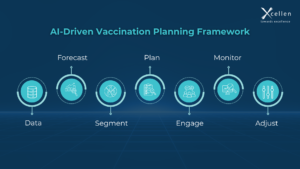
One of the most common challenges in vaccination strategy planning is not the strategy itself, but execution alignment. Planning teams may create forecasts and target lists, but field teams may not always have the tools or clarity needed to execute those plans effectively.
Common gaps include:
- Forecasts not translating into territory changes
- Segmentation not translating into call plans
- Engagement strategy not aligned with clinician preferences
- Data not updated frequently enough for field teams
AI can help reduce these gaps by connecting forecasting, segmentation, and planning into a single planning framework that supports both strategy teams and field teams.
AI will likely continue to play a growing role in vaccination strategy planning, particularly in forecasting, segmentation, engagement planning, and scenario modelling. However, technology alone is not enough. The real value comes when AI insights are integrated into planning workflows and field execution processes.
Organisations that treat AI as a planning support tool rather than a standalone technology initiative are more likely to see meaningful operational improvements.
Vaccination strategy planning is becoming more data-driven, more dynamic, and more interconnected across teams. AI can help organisations manage this complexity by improving visibility, supporting planning decisions, and helping teams allocate resources more effectively.
The focus should not be on AI as a trend, but on AI as a planning capability one that supports better coordination between data, strategy, and field execution.
At Xcellen, we continue to see that organisations that invest in clean data, structured planning, and explainable AI are better positioned to manage complex commercial planning environments, including vaccination strategy planning.