
Healthcare organisations have invested heavily in sales SaaS platforms, CRM systems, analytics dashboards, omnichannel orchestration tools, and AI-driven recommendation engines.
Yet a persistent question remains:
Why do many commercial teams still struggle to translate data into consistent, compliant action?
The answer often lies in a misunderstanding of what sales capability truly means.
Technology deployment is not a capability.
Capability is architecture.
And in healthcare, where regulation, scientific complexity, and trust intersect, architecture matters more than ever.
Sales capability is the structured ability of an organisation to convert evidence into responsible commercial action.
It includes:
- Data interpretation discipline
- Decision-making frameworks
- Compliance alignment
- Field execution readiness
- Continuous learning loops
It is not about volume calls logged, emails sent, or interactions counted.
It is about decision quality.
A 2024 McKinsey report on life sciences commercial productivity emphasises that organisations embedding analytics directly into frontline workflows, rather than isolating them in reporting environments see materially stronger adoption and performance impact.
Reporting informs.
Capability changes behaviour.
If sales capability is the ability, sales capability architecture is the system that makes that ability reliable and scalable.
In healthcare SaaS environments, this architecture typically includes five integrated layers:
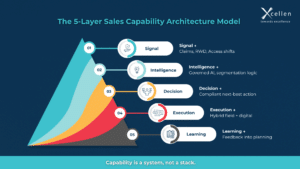
- Signal Layer – claims data, formulary shifts, RWD triggers, engagement metrics
- Intelligence Layer – governed AI models, segmentation logic, audit trails
- Decision Layer – compliant next-best-action frameworks
- Execution Layer – coordinated hybrid rep + digital engagement
- Learning Layer – feedback into territory planning and cost-to-serve models
Without integration, SaaS tools remain disconnected utilities.
With architecture, they form a coherent commercial system.
1. AI Governance Expectations Are Rising
Regulatory scrutiny around AI explainability and lifecycle governance is accelerating.
The EU AI Act, which entered into force in 2024, introduces obligations around documentation, transparency, and risk mitigation for high-risk AI systems.
In parallel, the U.S. FDA continues to evolve guidance on AI/ML-enabled software, including lifecycle transparency and risk-based oversight.
Deloitte’s 2024 Global Life Sciences Outlook notes that governance infrastructure not experimentation volume, is emerging as a defining characteristic of digitally mature organisations.
Healthcare SaaS platforms that cannot demonstrate traceability risk losing internal trust before generating field value.
The advantage is not AI deployment.
It is governed AI deployment.
2. Hybrid Commercial Models Require Sequencing Discipline
Hybrid engagement is now standard across markets.
But omnichannel presence does not guarantee orchestration maturity.
Accenture’s 2024 Life Sciences Commercial Trends analysis highlights that while multichannel engagement is widespread, integrated decision flows linking data triggers to coordinated action remain inconsistent.
What’s often missing is architectural clarity:
- Which signal triggers which action
- How marketing and the field coordinate
- How escalation pathways are defined
- How feedback refines targeting
SaaS enables omnichannel.
Architecture ensures coherence.
3. Cost-to-Serve Is Under Greater Scrutiny
Healthcare systems globally face sustained margin pressure.
In the United States, the Inflation Reduction Act (IRA) continues to influence long-term pricing strategy and lifecycle planning.
In Europe, the Corporate Sustainability Reporting Directive (CSRD) expands disclosure expectations, including operational transparency.
PwC’s Global Pharma Outlook 2025 underscores cost discipline in commercial operations as central to margin resilience.
Sales capability architecture enables:
- Evidence-based territory prioritisation
- Channel optimization
- Reduction of redundant outreach
- Improved time-to-action
Precision reduces operational waste financially and reputationally.
4. Real-World Evidence Is Expanding Faster Than Activation
The generation of real-world evidence continues to scale.
A 2025 commentary in Nature Reviews Drug Discovery discusses the expanding regulatory acceptance of RWE while highlighting variability in organisational operationalisation.
The constraint is rarely signal generation.
It is signal translation.
Architecture reduces latency between data availability and compliant action.
In competitive therapeutic categories, time compression matters.
It answers five operational questions:
- When a new data signal appears, who validates it?
- What governance ensures compliance?
- How is it translated into a clear recommendation?
- Is that recommendation explainable?
- How is performance feedback captured?
Organisations embedding these steps into workflow, not slide decks, move from reporting maturity to behavioural maturity.
Healthcare SaaS providers increasingly must support:
- Transparent AI logic
- Configurable compliance workflows
- Closed-loop performance tracking
- Territory-level integration
- Cross-functional visibility
The expectation is shifting from feature breadth to architectural enablement.
The platform should not merely surface insight.
It should support institutional learning
Without architecture:
- AI outputs lack trust
- Field teams revert to habit
- Compliance becomes reactive
- ROI remains unclear
- Digital investments plateau
Stack expansion does not equal system coherence.
Coherence determines measurable impact.
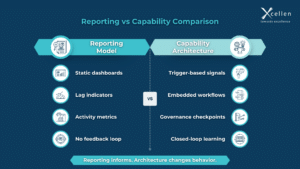
Indicators of strength include:
- Time from signal detection to field action
- Percentage of AI outputs with documented explainability
- Rep adoption rates of recommended actions
- Feedback incorporation into planning cycles
- Cross-functional alignment metrics
Commercial excellence is no longer defined by activity volume.
It is defined by decision clarity and execution integrity
Healthcare SaaS investment is entering a governance-driven phase.
The question is no longer:
Do we have advanced tools?
It is:
Does our commercial system translate evidence into consistent, compliant action and learn from it?
Sales capability architecture is the bridge between data abundance and responsible execution.
Before expanding the stack, ask:
Is the architecture strong enough to carry it?