
The future of pharma sales is increasingly defined by artificial intelligence, commercial excellence, omnichannel HCP engagement, and data-driven decision-making. As commercial environments become more complex, organisations are rethinking how they engage healthcare professionals (HCPs), allocate resources, and translate strategy into execution.
While innovation continues to accelerate across the pharmaceutical industry, commercial teams face a different challenge: transforming growing volumes of data, insights, and technology investments into effective field execution.
Today, success is no longer determined solely by product knowledge or market access. It depends on how effectively organisations align strategy, technology, and field operations to create meaningful engagement with HCPs and support more informed commercial decisions.
As the commercial landscape continues to evolve, several trends are emerging that will define the next phase of commercial excellence in life sciences.
What Is the Future of Pharma Sales?
The future of pharma sales combines AI-powered analytics, commercial excellence, sales force effectiveness, predictive decision-making, and omnichannel HCP engagement to support more informed commercial decisions. Organisations that successfully connect data, technology, and execution will be better positioned to adapt to changing customer expectations and increasingly complex commercial environments.
Future of Pharma Sales at a Glance
| Trend | Business Impact |
| AI-Powered Decision-Making | Supports data-driven commercial planning |
| Commercial Excellence | Improves decision quality and execution |
| Omnichannel Engagement | Enables more coordinated HCP interactions |
| Sales Force Effectiveness | Enhances resource allocation and territory planning |
| Predictive Analytics | Supports proactive decision-making |
| Digital-First Operations | Improves agility and collaboration |
| Human-Centred Adoption | Increases technology utilisation and trust |
Key Takeaways
- AI is becoming a critical enabler of commercial decision-making.
- Omnichannel engagement is evolving from channel management to experience orchestration.
- Sales force effectiveness remains central to commercial success.
- Data quality is becoming a competitive differentiator.
- Predictive analytics is supporting more proactive decision-making.
- Human-centred technology adoption is increasingly important.
- Commercial excellence requires alignment between strategy and execution.
Why Pharma Sales Are Changing
Life sciences organisations are operating in a more complex environment than ever before. HCPs are engaging across multiple channels, data volumes continue to grow, and commercial teams are under pressure to improve productivity while maintaining compliance.
At the same time, advances in analytics and automation are creating opportunities to improve how organisations design territories, allocate resources, segment customers, and plan engagement strategies.
The future of pharma sales will be defined by organisations that can combine technology, data, and human expertise to make better commercial decisions.
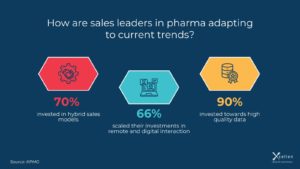
Trend 1: AI-Powered Commercial Decision-Making
Artificial intelligence is moving beyond experimentation and becoming part of everyday commercial operations.
Research from McKinsey & Company continues to highlight growing adoption of AI across commercial functions as organisations seek more effective ways to generate insights, improve forecasting, and optimise resource allocation.
Commercial leaders are increasingly exploring AI-driven approaches to:
- Customer segmentation
- Predictive analytics
- Call plan optimisation
- Resource allocation
- Channel mix planning
- Commercial forecasting
However, the focus is shifting from simply adopting AI to implementing explainable and transparent solutions that support business decisions.
As organisations expand their use of AI and automation frameworks, success increasingly depends on balancing innovation with governance, explainability, and commercial relevance. Commercial teams need to understand how recommendations are generated, how decisions can be validated, and how insights can be translated into action.
The organisations that derive the greatest value from AI will be those that combine advanced analytics with clear business accountability and human oversight.
Trend 2: Data-Driven Commercial Excellence
Data remains one of the most underutilised assets in many commercial organisations.
The importance of data quality is becoming increasingly recognised across industries. Insights from Deloitte consistently emphasise that organisations with stronger data foundations are better positioned to support decision-making, improve operational efficiency, and respond more effectively to changing market conditions.
While pharmaceutical companies have access to significant volumes of information, challenges around data quality, consistency, and accessibility often limit its value.
Commercial excellence increasingly depends on an organisation’s ability to:
- Integrate multiple data sources
- Improve data governance
- Generate actionable insights
- Create a single source of commercial truth
- Enable faster decision-making
Clean, reliable data helps commercial teams identify opportunities, optimise resource allocation, and improve planning accuracy.
Without a strong data foundation, even the most sophisticated analytics initiatives can struggle to deliver meaningful business value.
Organisations with mature commercial excellence strategies are increasingly focused on transforming fragmented data into actionable insights that support faster, more confident decision-making across sales, marketing, and field operations.
Trend 3: Omnichannel HCP Engagement Becomes More Sophisticated
HCP engagement continues to evolve as digital and in-person interactions become increasingly interconnected.
The focus is no longer on managing individual channels independently. Instead, organisations are looking to create coordinated engagement journeys that reflect how clinicians prefer to access information and interact with industry stakeholders.
Modern omnichannel engagement strategies focus on:
- Behavioural segmentation
- Personalised content delivery
- Coordinated channel planning
- Timing optimisation
- Continuous engagement measurement
Success depends on understanding both channel performance and customer preferences.
Commercial teams that can orchestrate relevant, timely interactions across channels are better positioned to build stronger professional relationships with HCPs.
Successful HCP engagement strategies increasingly combine behavioural insights, channel coordination, and personalised communication to create more relevant and valuable experiences throughout the engagement journey.
Trend 4: Sales Force Effectiveness Becomes a Strategic Priority
As commercial environments become more complex, organisations are placing renewed emphasis on sales force effectiveness.
Sales force effectiveness is no longer limited to performance measurement. It now encompasses territory design, target setting, resource allocation, incentive planning, customer targeting, and field force optimisation.
Leading organisations recognise that fair targets, balanced territories, and transparent planning processes contribute to more sustainable commercial performance.
Rather than focusing solely on outcomes, organisations are investing in the systems and processes that enable field teams to perform effectively.
Leading organisations are modernising their approach to sales force effectiveness by leveraging data-driven territory design, fair target setting, balanced resource allocation, and continuous performance optimisation that aligns planning with execution.
Trend 5: Predictive Analytics Drives Proactive Decision-Making
Commercial planning is becoming increasingly predictive.
According to research from PwC Strategy, predictive analytics is becoming an increasingly important capability for organisations seeking to improve planning accuracy and allocate resources more effectively in uncertain business environments.
Applications include:
- Market potential analysis
- Territory planning
- Resource optimisation
- Customer prioritisation
- Commercial forecasting
Predictive analytics allows commercial leaders to evaluate multiple scenarios before making strategic decisions.
The ability to simulate outcomes and assess alternative approaches can support more informed planning and resource allocation.
As predictive capabilities mature, organisations are integrating analytics into broader commercial data strategies that help teams move from reactive reporting to proactive decision-making.
Trend 6: Digital-First Commercial Operations Continue to Expand
Digital transformation remains a major focus across the life sciences sector.
Industry analysis from Accenture Life Sciences suggests that connected commercial ecosystems are becoming increasingly important for enabling data-driven decision-making, improving collaboration, and enhancing organisational agility.
Commercial teams are increasingly adopting cloud-based platforms and integrated technologies to improve efficiency, visibility, and collaboration.
The objective is not simply digitisation. It is creating connected commercial ecosystems that improve decision-making and execution.
As organisations seek greater agility, investments in territory management, customer targeting, and data-driven planning technologies are helping commercial teams align strategic objectives with field execution while maintaining operational consistency.
Trend 7: Human-Centred Technology Adoption
Technology adoption is ultimately a people challenge.
Research published by Harvard Business Review (https://hbr.org) frequently highlights that technology initiatives are most successful when organisations focus on people, processes, and adoption alongside technical implementation.
Many organisations invest heavily in new tools but struggle to achieve widespread adoption because users do not understand how those tools fit into their daily workflows.
The future of pharma sales will not be defined by technology alone. It will be defined by how effectively organisations enable people to use technology to make better decisions.
Frequently Asked Questions
What is the future of pharma sales?
The future of pharma sales is increasingly data-driven, combining AI-enabled insights, omnichannel engagement, commercial excellence, and sales force effectiveness to support more informed commercial decisions and stronger field execution.
How is AI changing pharmaceutical sales?
AI supports pharmaceutical sales teams through predictive analytics, customer segmentation, resource optimisation, forecasting, and commercial planning. Successful adoption depends on transparency, explainability, and regulatory compliance.
Why is omnichannel engagement important in life sciences?
Omnichannel engagement helps organisations deliver coordinated and relevant interactions across digital and in-person channels, creating more consistent and personalised experiences for HCPs.
The Future of Pharma:
The future of pharma sales will be shaped by the convergence of AI, commercial excellence, sales force effectiveness, predictive analytics, and omnichannel engagement. While technology continues to advance, sustainable success will depend on how effectively organisations combine innovation with practical execution.
The challenge is no longer access to information. It is transforming information into actionable insights that support better commercial decisions and stronger engagement with HCPs.