
Introduction
For most life-science organisations today, “omnichannel” is no longer an aspiration. It is a declared capability. CRM platforms are live, digital touchpoints are active, field teams are hybrid, and dashboards suggest continuous engagement.
And yet, performance variability remains stubbornly high.
This creates an uncomfortable tension: if omnichannel maturity is as advanced as we believe, why do outcomes still feel so uneven?
Pharma Omnichannel Strategy Gaps: When Confidence Outpaces Capability
Over time, omnichannel has quietly shifted from a discipline to a descriptor. It signals modernity, alignment, and progress. In many organisations, however, the term now functions less as a comfort word reassuring leadership while masking unresolved execution fundamentals. Industry research reflects this disconnect. McKinsey has noted that while most pharma companies now describe themselves as omnichannel, only a small minority have translated that ambition into consistently measurable commercial impact.
Has Confidence Outpaced Design in Pharma Omnichannel Strategies?
Most omnichannel strategies are still evaluated by presence:
- Are all channels available?
- Are campaigns coordinated?
- Are reps digitally enabled?
What receives far less scrutiny is how engagement decisions are actually made.
- Who decides which channel to use and when?
- What signals trigger a change in approach?
- How is judgment governed across brands, regions, and roles?
- Where does autonomy end and consistency begin?
This gap between deployment and decision design is not theoretical. A Deloitte survey of life-science commercial leaders found that fewer than one in five organisations consider their omnichannel model “advanced”, despite widespread investment in platforms and analytics. Most remain in early or intermediate stages, particularly when it comes to governance and execution consistency.
When these questions lack clear answers, omnichannel maturity is being assumed rather than validated.
True maturity is not a technological state.
It is a decision-quality state.
When Activity Replaces Orchestration
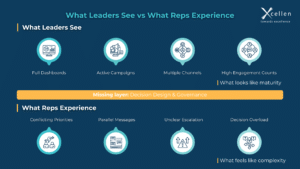
One reason omnichannel becomes a comfort word is that activity is easy to observe. Dashboards fill quickly. Campaign calendars stay busy. Engagement counts rise.
But activity is not orchestration.
In many commercial models, channels still operate in parallel rather than in sequence. Digital campaigns run adjacent to field conversations. Medical interactions are loosely aligned. Feedback loops are slow, informal, or fragmented.
The result is motion without coordination.
This disconnect is increasingly visible from the customer side as well. In recent global research on healthcare engagement, a meaningful share of physicians reported that the channel itself had little influence on perceived relevance, suggesting that coordination and content quality matter far more than channel mix. When engagement feels disconnected, more activity does not translate into greater impact.
Organisationally, however, visible motion often substitutes for meaningful progress. Leaders see activity. Field teams experience complexity.
Why Face-to-Face Still Drives Value in Pharma Sales
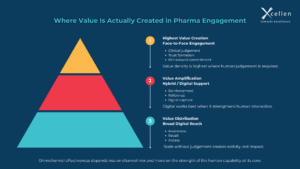
Despite rapid digitisation, face-to-face engagement remains the deepest value-creation layer in pharma sales, not because it is traditional, but because it concentrates judgement, trust, and contextual adaptation in ways other channels cannot fully replicate.
Prescribing behaviour rarely changes through information exposure alone. It changes when clinical relevance, confidence, and timing converge. That convergence still occurs most reliably in human interaction.
Face-to-face engagement matters because it enables three critical dynamics.
Contextual judgement
Reps continuously adapt conversations based on clinical cues, unspoken objections, and local practice nuances. This judgement is situational, not scripted. Digital channels can support it, but they cannot originate it.
Trust formation under uncertainty
Clinical decisions are made under ambiguity, evolving evidence, complex patients, and shifting guidelines. Peer-reviewed research in the Journal of Medical Marketing has shown that trust in the messenger significantly influences how information is interpreted and acted upon, particularly when uncertainty is high.
Behavioural commitment
The point of engagement is not message delivery, but behaviour change. Commitment is more likely when objections surface, risks are discussed, and intent is tested, dynamics that are difficult to compress into asynchronous channels.
This does not diminish the importance of digital. It clarifies its role. Digital works best when it amplifies strong human capability, not when it attempts to substitute for it.
Where sales capability is uneven, digital channels often magnify the gap. Strong reps use them to reinforce relevance. Weaker reps rely on them to compensate for uncertainty. In this sense, omnichannel does not level performance; it exposes it.
The Cost of Overstated Maturity
Overconfidence in omnichannel maturity carries real consequences.
First, it obscures the true drivers of performance variation. When results lag, organisations tend to add more content, more channels, or more technology rather than diagnosing capability gaps. McKinsey’s work on sales transformations repeatedly highlights role ambiguity, skill inconsistency, and weak coaching as the primary drivers of performance variation, far outweighing channel design.
Second, it inflates cost-to-serve. Redundant touchpoints, overlapping campaigns, and unclear prioritisation increase effort without improving outcomes.
Third, it erodes field credibility. Reps are expected to execute “orchestrated” strategies without clear guidance on sequencing, escalation, or judgment. What is labelled enablement can feel like noise.
None of these issues originates in the channels themselves.
They originate from insufficient design discipline.
Why Getting Back to Basics Matters Now
Commercial models are under increasing pressure: compressed launch windows, rising scrutiny on engagement integrity, sustainability expectations, and accelerating investment in AI-enabled tools.
Each of these amplifies whatever capability already exists.
As both MIT Sloan and Harvard Business Review have observed, technology rarely fixes weak fundamentals. It scales them.
In this context, overstating omnichannel maturity is risky. It delays necessary introspection and pushes organisations toward incremental optimisation of a system that may not be coherently designed.
Getting back to basics does not mean rejecting digital. It means re-examining first principles before adding complexity.
A More Useful Question
Rather than asking, “Are we omnichannel?” a more revealing question may be:
“Where has our engagement model measurably improved decision quality?”
If that improvement is hard to locate in field behaviour, coaching conversations, or customer experience, omnichannel may be functioning more as reassurance than as capability.
Comfort words feel good.
Progress requires precision.