
Introduction: Why 2026 Is an Execution Test for Pharma
As the pharmaceutical industry enters 2026, innovation is no longer constrained by technology availability. Artificial intelligence, advanced therapeutics, and digital engagement models are firmly established across the value chain. The real differentiator now lies in execution discipline.
For commercial leaders, this shift has direct implications. Commercial Excellence and Sales Force Effectiveness are increasingly shaped by how well organisations translate innovation into repeatable, compliant, and human-centred operating models. While prevailing trends point to progress, they also expose structural and operational risks that are often underestimated.
Trend 1: AI Moves from Experimentation to Accountability
AI continues to expand across commercial and operational functions, supporting forecasting, segmentation, and decision support. By 2026, the conversation had shifted from adoption to accountability.
Commercial teams are now expected to justify AI-driven recommendations with transparent logic and measurable relevance. Explainability, data lineage, and governance are no longer optional.
Execution risk:
AI initiatives that lack operational ownership or clear use cases frequently stall. Rather than accelerating productivity, poorly integrated models can slow decision-making and reduce trust among field teams.
Implication for Commercial Excellence:
AI must be embedded into planning workflows, not layered on top of them. Value emerges when insights are defensible, timely, and aligned with commercial realities.
Trend 2: Data-Driven Commercial Strategy Becomes the Default
Real-time data platforms and advanced analytics are redefining how commercial strategies are built and adjusted. Segmentation, targeting, and resource allocation are increasingly dynamic rather than static annual exercises.
This evolution strengthens alignment between strategy and execution when supported by clean, connected data.
Execution risk:
Over-automation can weaken contextual decision-making. When human judgment is sidelined, engagement strategies risk becoming uniform rather than personalised.
Implication for SFE:
Sales effectiveness improves when analytics guide prioritisation, but field teams still require autonomy to adapt insights to real-world interactions with HCPs.
Trend 3: Advanced and Precision Therapeutics Reshape Commercial Models
Precision medicine, cell and gene therapies, and biomarker-driven development continue to expand pipelines. These therapies demand highly specialised commercial approaches, smaller target populations, and deeper scientific engagement.
Execution risk:
Commercial readiness often lags scientific progress. Field models built for scale struggle to adapt to complexity, leading to misaligned coverage and capability gaps.
Implication for Commercial Excellence:
Success depends on integrated planning across medical, market access, and commercial teams supported by flexible territory and targeting models.
Trend 4: Supply Chain Resilience Influences Commercial Confidence
Operational resilience has become a strategic priority, with investments in predictive analytics, localisation, and scenario planning. These efforts increasingly influence commercial planning and launch confidence.
Execution risk:
Technology investment alone does not address workforce capability constraints. Skills shortages in analytics and operations continue to limit the effectiveness of resilience initiatives.
Implication for SFE:
For Sales Force Effectiveness, consistent product availability and credible planning assumptions are critical to sustaining meaningful engagement with HCPs. When supply plans are misaligned with field communication, such as optimistic launch timelines or inconsistent availability, sales teams risk losing credibility. Over time, these gaps can erode HCP trust and reduce the effectiveness of even well-designed engagement strategies.
Trend 5: Trust Becomes a Commercial Differentiator
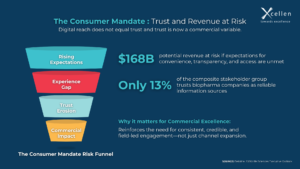
Expectations around transparency, relevance, and engagement quality continue to rise. Digital channels are now standard, but trust remains fragile across markets and stakeholders.
Execution risk:
Technology-led engagement without clear value exchange can amplify scepticism rather than reduce it.
Implication for Commercial Excellence:
Trust is built through consistency across data quality, engagement cadence, and field behaviour. Digital sophistication must be matched with human credibility.
What This Means for Commercial and Field Leaders
Across all five trends, a consistent pattern emerges: innovation is increasing complexity faster than organisational capability. By 2026, Commercial Excellence is less about acquiring new tools and more about creating coherence across strategy, data, and field execution.
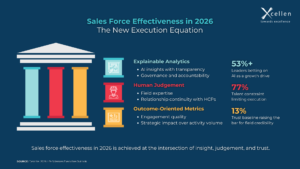
AI, advanced analytics, and digital engagement models are now widely available. What differentiates performance is whether commercial organisations can integrate these capabilities into clear decision frameworks, supported by explainable analytics and trusted by field teams.
Sales Force Effectiveness, in particular, is entering a recalibration phase. Activity volume and channel coverage are no longer reliable proxies for impact. As HCP expectations rise and trust remains fragile, effectiveness depends on judgment, relevance, and consistency supported, but not dictated, by technology.
Looking ahead, high-performing commercial organisations will focus on three execution priorities:
- Decision clarity: Ensuring AI and analytics support transparent, defensible commercial decisions rather than opaque recommendations.
- Balanced enablement: Equipping field teams to combine digital insight with professional judgement and scientific credibility.
- Meaningful measurement: Shifting KPIs toward engagement quality, continuity, and outcome relevance rather than activity counts.
In this environment, Commercial Excellence and SFE become less about transformation programmes and more about operating discipline where technology, talent, and trust reinforce one another.
Conclusion: 2026 Rewards Disciplined Execution
Pharma’s future trajectory is shaped by powerful trends, but outcomes will be determined by execution choices. AI, advanced therapies, and digital platforms offer scale and precision, yet they also expose gaps in data foundations, workforce capability, and trust.
Organisations that treat Commercial Excellence and Sales Force Effectiveness as integrated, evolving systems rather than technology programmes will be better positioned to navigate 2026 with confidence.
To explore how life sciences organisations can translate these trends into practical, compliant commercial execution, access Xcellen’s latest perspectives on Sales Force Effectiveness and data-driven Commercial Excellence.