
Introduction
The previous article established that modern prescribing decisions emerge from an ecosystem rather than a single clinician. The next step is understanding how this ecosystem behaves today. What was once a slow-moving, largely invisible network is now a dynamic, data-connected system that influences decision-making continuously.
For commercial leaders, this shift transforms not only how influence is understood but also how engagement and resource planning should be executed.
From Individual Influence to Dynamic Ecosystems
Commercial models traditionally focused on individual prescribers. Yet today’s healthcare environment functions as a network of roles, policies, and digital systems. What is changing now is the speed at which these influences interact and the visibility available to commercial teams.
Three industry trends are driving this change:
1. Integrated Clinical Workflows
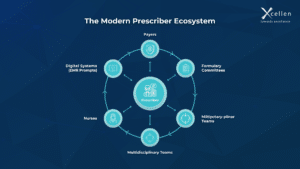
Care delivery increasingly involves teams of nurses, pharmacists, educators, and formulary committees shaping therapy pathways collaboratively.
2. Digitised Point-of-Care Environments
Clinical software, formulary rules, and automated prompts introduce structured decision signals at the moment of care.
3. Data-Enabled Commercial Operations
Aggregated operational and engagement data allows organisations to observe patterns that reflect how ecosystems behave over time, not just historically. Together, these trends create decision environments that are fluid, interconnected, and shaped by both human and system-level factors.
How the Prescriber Ecosystem Now Functions in Real Time
“Real-time” in this context does not refer to clinical data or patient information. It reflects operational signals that indicate how behaviours or institutional rules are shifting.
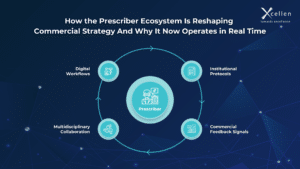
1. Digital Inputs that Guide Choice Architecture
Formulary prompts, care pathway cues, or workflow reminders shape prescribing decisions at the point of care. These cues often carry significant influence because they are embedded into clinicians’ daily practice.
2. Institutional Decisions with Immediate Impact
Changes in coverage, internal guidelines, or treatment pathways can alter decision patterns across entire networks almost instantly. Such institutional shifts often matter as much as individual preferences.
3. Multidisciplinary Dialogue Loops
Many therapy areas rely on frequent case discussions. When teams meet weekly or
bi-weekly, new information spreads quickly, creating rapid behavioural alignment.
4. Commercial Feedback Signals
Engagement touchpoints, whether digital or in-person, contribute to a broader understanding of ecosystem interactions. When integrated into analytics workflows, they help identify influence chains, emerging barriers, and shifts in sentiment across stakeholder groups.
This is the foundation of dynamic ecosystem intelligence: a view that evolves continuously rather than remaining fixed on historical activity.
Why Real-Time Ecosystem Understanding Matters for Commercial Excellence
Many traditional models still prioritise individual prescribers without recognising the enabling structures behind them. But real-world behaviour shows that influence is rarely concentrated in a single role.
A system-level view supports commercial teams in:
- identifying stakeholders who silently shape access or operational feasibility
- understanding where influence clusters or bottlenecks appear,
- prioritising engagement based on ecosystem connectivity, and
- aligning omnichannel strategy with real-world care delivery structures.
This enables a more accurate understanding of where decisions are shaped and where
engagement can be more relevant.
Operationalising Ecosystem Intelligence
Ecosystem mapping becomes transformative when aligned with a data strategy. Instead of
static segmentation, teams can build dynamic models that reflect how decision-making
evolves.
Organisations can use ecosystem insights to explore:
1. Network-Based Segmentation
Segmenting stakeholders not by prescribing volume but by influence patterns,
cross-functional roles, and institutional responsibilities.
2. Ecosystem Trigger Identification
Understanding which operational signals guideline updates, formulary changes, and
workflow prompts shift decision behaviour.
3. Adaptive Engagement Planning
Using aggregated insights to refine omnichannel sequencing, address information gaps, and build multi-stakeholder dialogue rather than isolated interactions.
This approach reinforces the link between data strategy, engagement design, and execution excellence.
A New Engagement Model: Orchestrating Ecosystems
Ecosystem thinking moves the industry from “targeting prescribers” to orchestrating systems of influence.
This includes:
1. Multi-Stakeholder Engagement
Recognising the roles of pharmacists, nurses, pathway leads, and administrators in shaping feasibility and access.
2. Integrated Commercial Planning
Aligning field, medical, access, and analytics teams around a shared understanding of how decisions happen.
3. Continuous Ecosystem Monitoring
Tracking shifts over time helps commercial teams stay aligned with real-world behaviour rather than relying on historical assumptions.
At Xcellen, we see organisations gaining greater clarity when they shift from isolated insights to connected ecosystem intelligence.
Conclusion
The prescriber ecosystem is now a living, responsive system shaped by people, institutions, and digital workflows. By understanding how these forces interact in near real time, commercial teams can align their strategies with how decisions actually occur.
The future of commercial excellence lies not in targeting individuals but in understanding and ethically engaging the full ecosystem that shapes therapeutic decisions.