Introduction
CRM Integration in Life Sciences Is a Strategic Imperative
What if the biggest risk to commercial decision-making in life sciences is not the strategy but the data trail behind it?
CRM integration in life sciences has always been a defining factor in how effectively commercial strategy translates into execution. While pharmaceutical organisations invest heavily in segmentation, targeting, and territory planning, misaligned systems often undermine these efforts.
Yet when CRM systems and planning tools operate in isolation, delays, inconsistencies, and manual processes directly influence commercial outcomes.
In regulated commercial environments, disconnected systems are not merely inefficient; they introduce operational and governance risk.
Understanding CRM Systems in Pharma Commercial Operations
Customer Relationship Management (CRM) systems form the operational backbone of commercial operations in life sciences.
They capture and structure:
- HCP engagement activity
- Field interactions and call frequency
- Territory assignments
- Channel touchpoints
- Execution feedback
CRM platforms serve as the system of record for field execution. They provide visibility into how commercial strategy unfolds in real-world settings.
However, CRM systems alone do not define commercial direction. Strategic decisions, profiling, segmentation, target setting, resource allocation are often conducted in separate analytical platforms.
Without effective CRM integration in life sciences, this separation creates friction between planning and execution.
The Commercial Impact of Poor CRM Integration
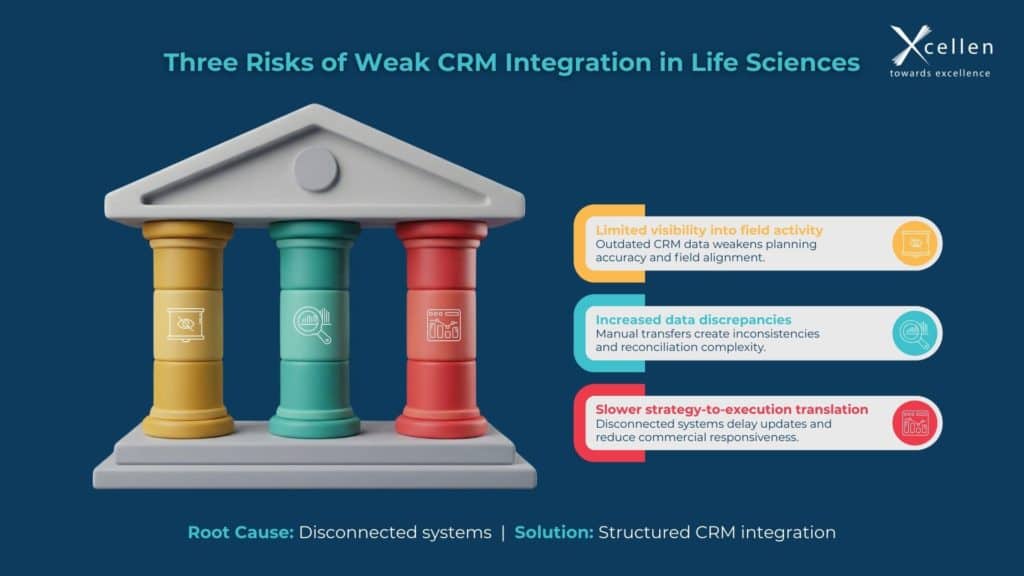
When pharma CRM integration is weak or absent, three recurring challenges emerge:
CRM Integration in Life Sciences
1. Limited Visibility into the Latest Field Activity
Commercial planning may rely on outdated CRM data, weakening strategic assumptions.
2. Increased Risk of Data Discrepancies
Manual uploads, reconciliations, and spreadsheet-based processes introduce inconsistency.
3. Slower Translation of Strategy into Execution
Even strong commercial plans stall when CRM data synchronisation is delayed or incomplete.
These issues do not reflect a poor strategy. They reflect disconnected systems.
CRM integration in life sciences directly affects how quickly insight becomes action.
Why CRM and Commercial Planning Alignment Matters
Commercial excellence depends on more than analytics. It depends on structured CRM and commercial planning alignment.
Effective CRM integration enables:
- A unified and consistent commercial data view
- Controlled CRM data synchronisation
- Reduced manual reconciliation
- Transparent documentation for governance and audit
In life sciences, where compliance and auditability are essential, integration is not optional. It is foundational to responsible commercial operations.
Disconnected systems create ambiguity.
Integrated systems create accountability.
CRM Integration in Regulated Commercial Environments
Pharmaceutical organisations operate under strict governance frameworks. Data integrity, traceability, and audit readiness are non-negotiable.
CRM integration in life sciences must therefore support:
- Transparent data movement
- Controlled access and synchronisation
- Alignment with enterprise governance standards
- Configurable, auditable workflows
The objective of pharma CRM integration is not to move more data between systems.
It is to move the right data securely, predictably, and in alignment with regulatory expectations.
Operational Benefits of Structured CRM Integration
When CRM integration in life sciences is structured and controlled:
- Field insights inform commercial planning decisions more reliably
- Updated targets and territories reflect current execution realities
- Commercial leaders gain end-to-end visibility
- Governance standards remain intact without increasing administrative burden
Commercial operations become clearer, not more complex.
The strength of the data trail becomes a competitive advantage in decision-making.
Xpower Connect: Enabling CRM Integration in Life Sciences
Xpower Connect is designed to support structured CRM integration in life sciences by acting as the integration layer between Xpower and an organisation’s CRM environment.
Rather than replacing existing CRM platforms, it defines:
- What data moves
- When it moves
- In which direction it flows
This controlled CRM data synchronisation ensures that commercial planning and field execution remain aligned, current, and auditable.